
Press Releases
Proposed Clearfield whitewater park · concept design imagery.
Whitewater Park Engineering & Design Update
Media Handout: Whitewater Park Engineering & Design Update
Date: February 12, 2026
Contact: Rob Swales, Chief Executive Officer, Clearly Ahead Development
Phone 814-768-7838,
CLEARFIELD, PA – Whitewater engineers Scott Shipley and Riley Adams of Calibre Engineering, Inc. recently conducted site visits to the Raftsman Dam in Clearfield and Pee Wee’s Nest Dam in Irvin Park, Curwensville, as design work continues on the proposed Whitewater Recreation Parks.
Bathymetric survey data has been collected at both locations. The project has now entered into the two-dimensional hydraulic modeling phase. This modeling will support multiple state and federal permitting requirements and help refine the design of the proposed in-water structures.
During the site visits, engineers identified potential water trail access points both upstream and downstream of the proposed features to help ensure ADA-accessible public access. The project team continues to evaluate how the designs can improve river safety, maintain upstream water elevations, and enhance fish and aquatic habitat.
The Whitewater Recreation Parks initiative is intended to enhance public river access while providing a sustainable alternative to aging low-head dams. The design concept seeks to preserve the recreational and cultural value of local waterways while improving environmental conditions and public safety.
In December 2024, Calibre Engineering (Highlands Ranch, CO) was selected as the lead design firm. The company is collaborating with Stahl Sheaffer Engineering (Clearfield, PA) to oversee preliminary and final design, permitting, and bidding support services for both the Clearfield and Curwensville project areas.
Throughout 2025, Town Hall and public meetings were held in both communities to provide project updates, answer questions, and gather public feedback. While community perspectives remain mixed, project partners continue to advance the planning and engineering process.
Curwensville Borough and Clearly Ahead Development have since partnered to submit competitive grant applications to support future construction of the whitewater feature in Irvin Park. Rob Swales, Clearly Ahead Development, CEO expressed, “This initiative represents more than a local recreation project — it reflects a broader vision for how Pennsylvania can reimagine its waterways for the next generation. Across the Commonwealth, there is growing momentum to remove or modernize non-flood control low-head dams in ways that improve public safety, restore natural river function, and expand outdoor recreation. By exploring innovative whitewater design solutions, our communities are positioning themselves at the forefront of that movement — enhancing environmental stewardship, strengthening tourism, and creating vibrant riverfront destinations that honor both our heritage and our future.” The proposed improvements aim to enhance outdoor recreation amenities for local residents while strengthening regional tourism opportunities.
For more information, including a Frequently Asked Questions (FAQ) document and the original Whitewater Parks Feasibility Study, visit www.ClearlyAhead.com.
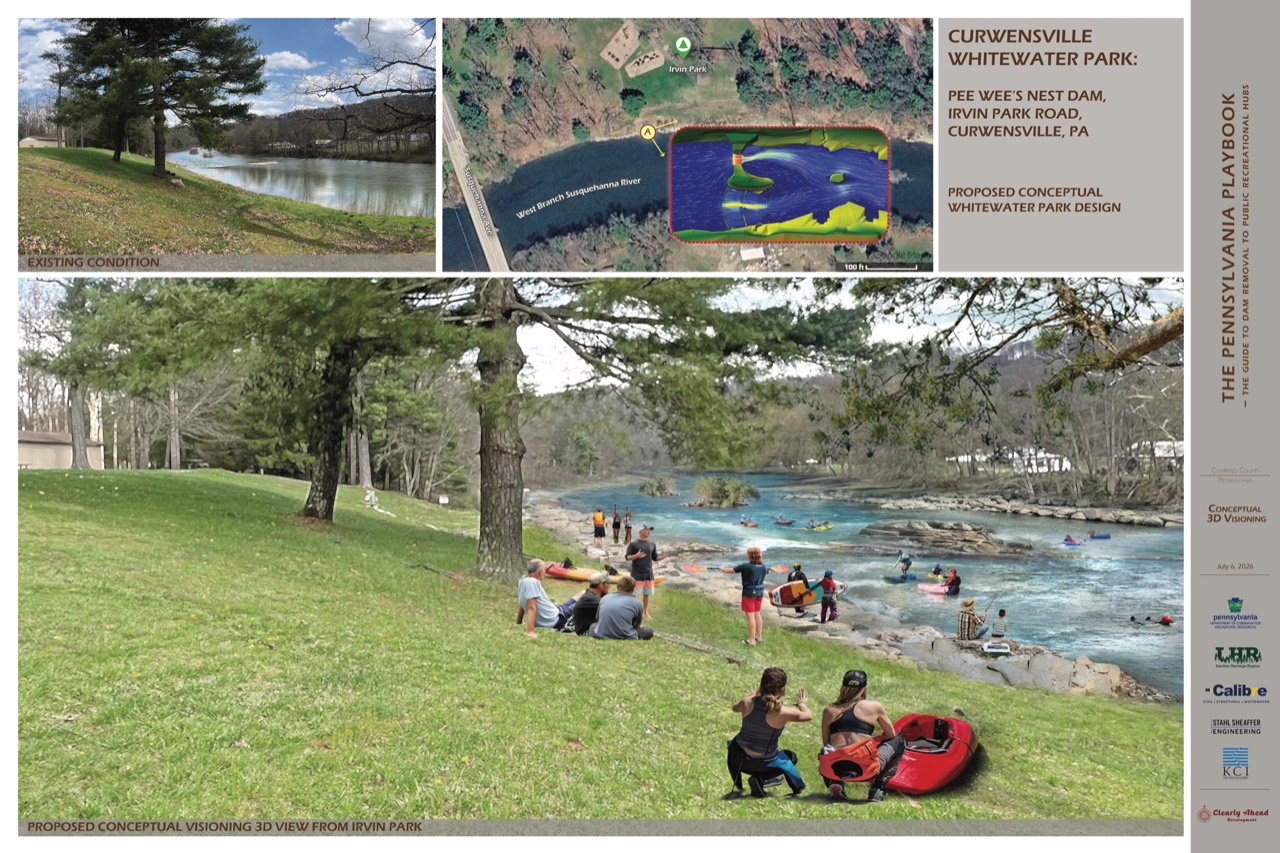
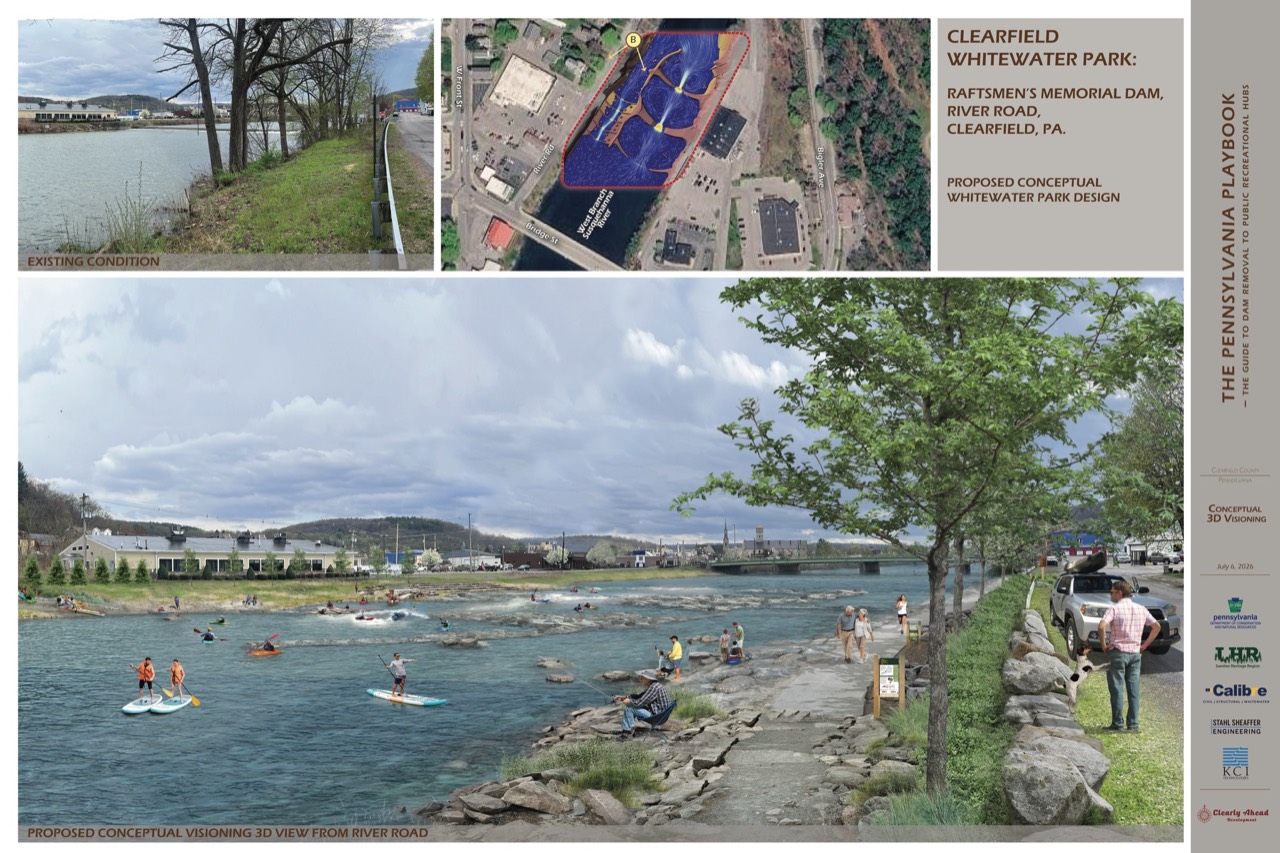
Proposed Whitewater Recreation Parks: 2026 Concept Renderings
Concept renderings supplied by Clearly Ahead Development show the proposed recreation projects in Clearfield and Curwensville. These are planning concepts, not photographs of completed facilities.
Curwensville — Pee Wee’s Nest Dam
Clearfield — Raftsmen Memorial Dam
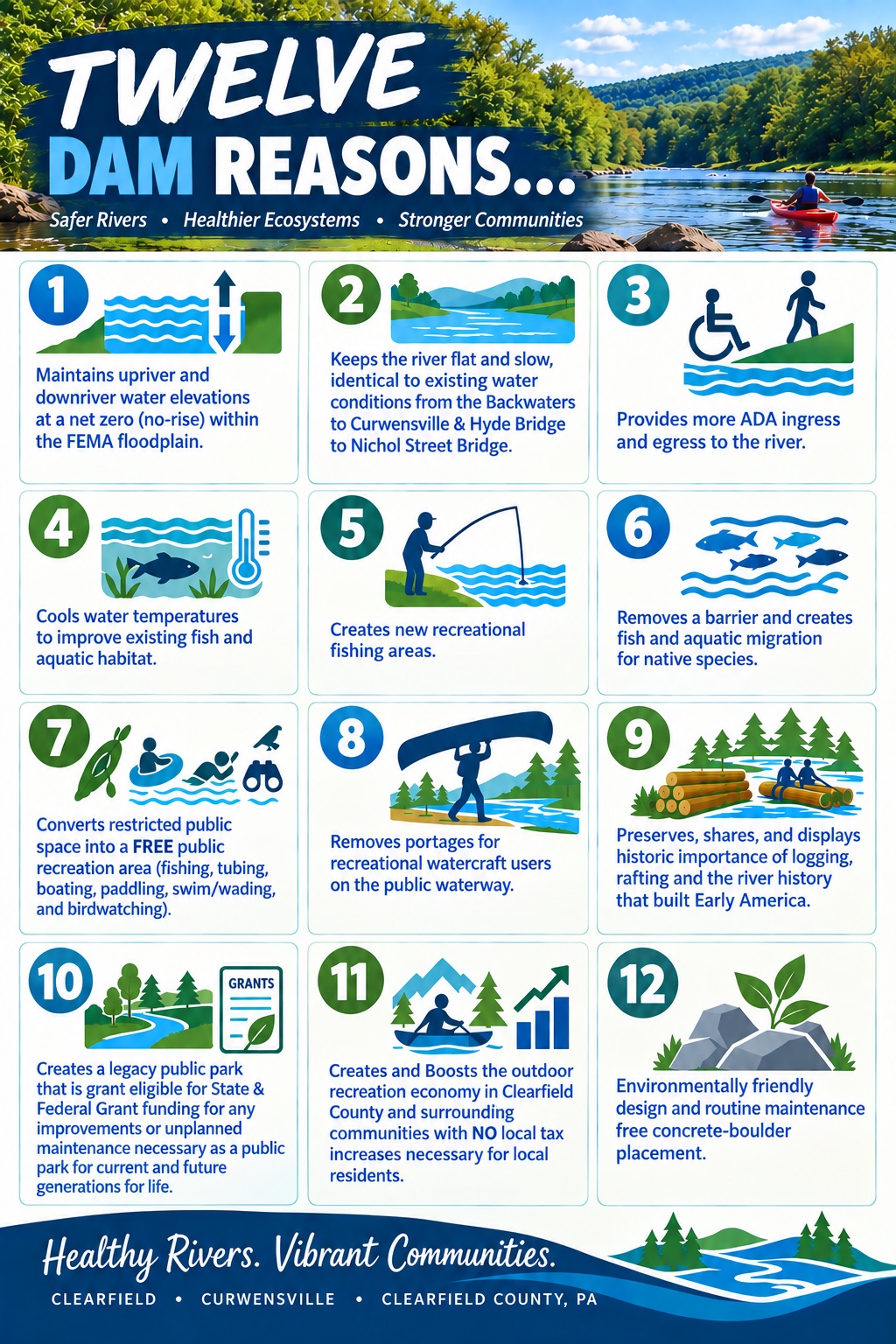
Twelve Dam Reasons
Project information graphic supplied by Clearly Ahead Development, dated September 11, 2026.
View the full-size Twelve Dam Reasons project information graphic
Frequently Asked Questions about Clearfield-Curwensville Low-Head Dam Removal and Public Recreational Whitewater Parks
1. What is a low-head dam, and why is it proposed to be removed?
Low-head dams are structures built across rivers or streams to manage water flow, but they are often only a few feet high, creating a "drop" in the water level. These dams have limited utility today and can be extremely hazardous, as they create dangerous currents that can trap people and debris. Removing dams improves river safety and a community hazard, restores natural ecosystems, and opens the way for recreational use.
2. Why replace low-head dams with whitewater park features?
Replacing dams with whitewater park features creates a controlled and safer environment for recreational activities like kayaking, tubing, and canoeing while maintaining upriver and downriver surface water elevations consistent with the seasonal levels the community is accustomed to experience. Whitewater parks attract visitors, boost tourism, and offer a community asset. Whitewater parks foster connection to the downtown merchants, while allowing the waterway to flow naturally, benefiting both the environment and public enjoyment.
3. How does removing low-head dams benefit the local ecosystem?
Low-head dams disrupt natural water flow, which affects fish migration, sediment transport, algae growth, and the overall health of aquatic ecosystems. By removing the dams, water flows more freely, helping restore natural habitats, improve water quality, and support wildlife. Fish passage improvements are designed to support fishing activities and biodiversity.
4. Will a dam removal and replacement project affect local property values?
Yes, replacing low-head dams with whitewater parks has a positive impact on property values, especially for waterfront properties. Economic Impact studies show that communities with access to recreational water features often experience increased property values, create more business opportunities, create higher demand for nearby real estate, and stimulate greater community pride.
5. How will public safety be addressed with these new recreational features?
Safety is a top priority. Unlike low-head dams, whitewater parks are designed with controlled currents to eliminate the hydraulic features associated with dams. Areas will include safety signage, and designated zones for various skill levels. Trained swift water rescue personnel from local fire departments and rescue paddle groups will find the parks attractive areas for local and regional rescue exercises. As a public recreation area, safety features, such as rescue stations, and park rules and regulations are included to ensure a safe experience for all visitors.
6. How will the project be funded?
Funding for dam removal and whitewater park construction often comes from a combination of state and federal grants, local contributions, private donors, and sometimes from specific economic development funds. These projects are often eligible for environmental and recreation-focused grants due to their community and ecological benefits. The goal is to have construction of the public park(s) 100% funded by use of grant programs. This strategy is a community wide initiative that includes many key partnerships locally, including but not limited to the Curwensville Regional Development Corporation, Clearfield Revitalization Corporation, Visit Clearfield County, Clearly Ahead Development Corporation, Clearfield County Conservation District, and local municipalities.
7. Will this project increase taxes?
Municipal impacts vary depending on the project’s funding sources and structure. Federal, state, and local grants and other funding sources are planned to be used to eliminate local tax burden and minimize local community investment. No specialty tax increases, assessments or fees are necessary for the project.
Studies show that communities with access to recreational water features often experience increased property values, more business opportunities, and higher demand for nearby real estate and business services. This creates growth in tax revenue generation for a municipality without increasing tax rates.
8. How long does it take to complete a low-head dam removal and whitewater park project?
The timeline varies based on the size and complexity of the dam and the design of a whitewater park. On average, projects can take between two to three years, including planning, permitting, construction, and final site work. The timeline is communicated to the community throughout each stage of the project. The first phase of planning and permitting is anticipated to take 12-18 months. Construction and final site work is expected to take 12-18 months thereafter.
9. What recreational activities will be available at the new whitewater park?
Only 1 out of 7 visitors to a whitewater park get wet! That’s right, Six out of 7 visitors do not participate in the water during their visit. Whitewater parks are designed to support a range of water sports, including kayaking, canoeing, tubing, paddleboarding, fishing, swimming, and sometimes surfing. Park visitors will likely have surrounding walking and bicycle trails, picnic, spectator areas, and spaces for community events to enhance the experience for all.
10. Will the project impact flood risk?
No, removing low-head dams generally decreases flood risks and ice jams associated with dams because it improves water flow. Engineers assess flood impact in the design phase to ensure the whitewater features accommodate natural river flow, even during high-water events, further reducing the chance of flooding while preserving and maintaining seasonal upriver surface water elevations that the community is accustomed to experience. One-hundred-year FEMA Flood Plains will not be affected above or below the whitewater recreation park.
11. How will this project impact local businesses?
Whitewater parks often increase local tourism, benefiting nearby businesses such as restaurants, retail shops, and outdoor equipment rentals. By creating a destination for visitors, these parks support economic growth and increase customer traffic, positively impacting the local economy. Recent economic impacts report communities (population sizes of 8,500) experience $750,000 to $6 million annual benefits directly to their community and the creation of 50-100 direct jobs locally.
12. Will fish and other wildlife be able to use the river with the new whitewater features?
Yes, whitewater park designs incorporate fish and bird friendly features that allow wildlife species to move up and downstream. These structures are created to maintain or improve the natural ecosystem, allowing fish migration and habitat restoration while supporting recreational use.
13. What are the maintenance costs for a public whitewater park?
Public Whitewater Park maintenance is consistent with on-land public parks. Communities may anticipate the need for seasonal sidewalk snow removal, sanitation removal, power washing and flood debris cleanup from common trail areas in the event of 100–500-year rainfalls. As for waterways, like dams, if a large tree becomes stuck, the community has the option to let Mother Nature run its course or remove the debris or accumulated silt with a backhoe. A backhoe may reach out from areas designed in the engineering process and permitted to do so per US Army Corp. Engineer’s 404 Permit. This permit is required and obtained prior to park construction to safely restore and maintain the chemical, physical, and biological integrity of our Nations’ waterways.
14. How will this park affect insurance costs for the community?
It is recommended for all public parks to be added to a municipal general liability policy at a minimal fee and likely cost less than a general liability policy associated with low head dam coverage. Like the liability cost of a dam, estimates range from $350-$750 annually for $1 million in general liability coverage for a public whitewater park. Historic evidence shows the river is a public waterway and liability is drastically mitigated by use of safety, rules and regulation signage.
15. How will the whitewater parks be named?
This is extremely important and must involve a community effort to prominently recognize the important roles our river towns, and townspeople endured along the West Branch of the Susquehanna River from the early days of colonizing rural Pennsylvania and America. This is an amazing story and requires partnership with local historic societies and heritage groups to memorialize local history for all visitors to enjoy along the Susquehanna River Trail.
16. How can residents provide input or stay informed about the project?
Yes, communities will host public meetings, workshops, and informational sessions for residents to provide feedback. Key stakeholders and municipal officials will serve as points of contact and will be asked to participate in monthly engineering meetings that will be conducted in the project areas. This will ensure the public is informed. Project updates will be available through local government websites, social media, and news publications inform residents at each stage of planning and development.
Let’s talk about your next opportunity.
Tell us what you’re planning. We’ll help you find the next step.